

Xml Binary Option Yes Or No
- Overview
- Dropdown
- Relieve label of selected value in variable
- Calculation subtitles within a dropdown
- Accessing Dropdowns with JavaScript
- The
optionsArray - Looping through the options Array
- Adding Options
- Removing Options
- Changing a textbox depending on a dropdown'southward selection
- Accessing Dropdowns with PHP
- Manually Populating Dropdowns
- Querying the $_DBArray
- Populate a Dropdown with a Database Query
- Populate a Dropdown from a Grid
- Passing JSON Strings of Options
- Passing Database Queries To Dropdowns
- Saving Lists of Dropdown Options
- Saving Dropdown options as a JSON cord
- Saving Dropdown Options as a serialize() string
- YesNo
- Accessing Yes/No Boxes with JavaScript
- Accessing Yeah/No Boxes with PHP
- Listbox
- Accessing Listboxes with JavaScript
- Accessing Listboxes with PHP
- Manually Populating Listboxes
- Preselecting Options in Listboxes
Overview
Dropdown boxes, yes/no boxes and listboxes allow a user to select option(s) from a list of predefined options.
 Dropdown
Dropdown boxes allow the user to select a unmarried pick from a list of predetermined options which drop down.
Properties
- Field Name *Required
- Label
Behavior
- Required
- Read Only
- Dependent Fields
- Default Value
- Save characterization of selected value in variable
Advent
- Style
Data
- Sql Connection
- Sql
Options
Dropdown boxes are used considering they save space compared to listboxes, just dropdown boxes practise non allow multiple selections and the user is forced to utilise the mouse to display the list of available options.
An option can be selected by clicking one time on the dropdown box to display the list of options and and then clicking a second time on the choice to be selected. Alternatively, an option can be selected by holding downwardly on the right mouse button to display the list and then moving the mouse cursor to an pick and releasing the mouse mouse.
To select an choice with the keyboard, utilize the TAB or SHIFT+TAB to bring the focus to the dropdown box. Press the Upwards or LEFT arrow primal to select the previous option in the list. Press the DOWN or Right arrow key to select the next pick in the listing. Printing Domicile to select the first option in the listing and Terminate to select the final choice. Pressing a letter of the alphabet or number key will motion the pick to the first selection whose label starts with that letter or number. Pressing the same letter or number once again moves to subsequent options starting with that letter or number. There is no way to brandish the list of options with the keyboard, but once the list is displayed with a single click, the keyboard can be used to motion the selection. To select the current option and hide the listing, press ENTER or TAB.
Each option in dropdown boxes have both a value, which is what is stored when a user selects an option and the label, which is the text displayed to the user. A dropdown box has have its list of options divers in its XML definition. In addition, it tin can append extra options to the listing with an SQL SELECT statement.
Save label of selected value in variable
Activate this option to save the label of the selected option for a dropdown box. The characterization will be saved as a instance variable with the aforementioned name equally the dropdown box, but with "_label" appended at the finish. For instance, if a dropdown box is named "MyDropdown", then the value of the selected option would be stored in the case variable @@MyDropdown and the label of the selected selection would exist stored in the case variable @@MyDropdown_label.
XML Definition:
- <NAME ... savelabel="0|i" ...>... </NAME>
Note: In version 2.0 and later, the savelabel="0|1" property has been eliminated considering the instance variables @@ field-name _label are automatically created to salvage the label of the selected option.
Case:
If there is a dropdown named "Country", then its instance variable holding the label of the selected option will exist @@Country_label. This is also applied for radiogroups and listboxes.
Adding subtitles inside a dropdown
Available Version: From two.5.1 on.
The improver of subtitles will help users to categorize and group a list of values extracted from queries, specially if they take to insert more than 1 query inside a dropdown. To enable subtitles inside a dropdown a optgroup attribute inside the XML must be added with a value of 1. The example below volition guide y'all in the creation of subtitles:
Create a dropdown field with the following structure:
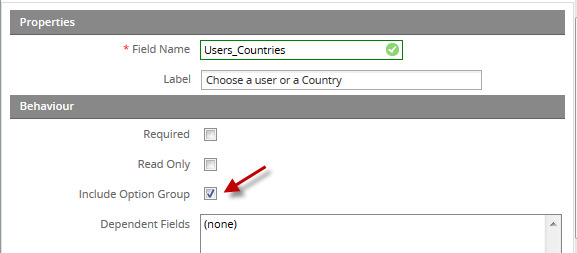
As you can see, there is a new aspect named "Include option group", by clicking on that option, the use of subtitles volition be bachelor, by adding an option next to each dropdown value:

Inside the XML, the aspect added will be:
<Users_Countries type="dropdown" optgroup="1" fashion="edit" >
</Users_Countries>
Then create queries to be displayed in the dropdown, for this case, let'southward create ii queries, to list users and to list countries:
( SELECT 'optgroup1' AS UID, 'Users' AS NAME)
UNION
( SELECT USR.USR_UID AS UID, USR.USR_USERNAME AS NAME
FROM USERS AS USR
WHERE USR.USR_USERNAME <> '' AND USR.USR_USERNAME LIKE '%a%'
)
UNION
( SELECT 'optgroup2' AS UID, 'Countries' Every bit Name)
UNION
( SELECT COUNTRY.IC_UID AS UID, COUNTRY.IC_NAME AS NAME
FROM ISO_COUNTRY AS COUNTRY
WHERE Country.IC_NAME Similar 'b%'
)
In both cases it is required to have optgroup inside the query, this will work as the ID of the subtitle, and two, i for Users subtitle and the other for Countries subtitle. And then employ UNION to join both queries and to exist displayed on the same dropdown.
Salvage your dynaform and the final XML will be:
<Users_Countries type="dropdown" optgroup="one" mode="edit" >
<![CDATA[ (SELECT 'optgroup1' Equally UID, 'Users' AS NAME)
UNION
(SELECT USR.USR_UID AS UID, USR.USR_USERNAME As NAME
FROM USERS AS USR
WHERE USR.USR_USERNAME <> '' AND USR.USR_USERNAME Like '%a%'
)
Spousal relationship
(SELECT 'optgroup2' AS UID, 'Countries' As NAME)
Matrimony
(SELECT State.IC_UID Every bit UID, COUNTRY.IC_NAME AS Proper noun
FROM ISO_COUNTRY Equally COUNTRY
WHERE State.IC_NAME LIKE 'b%'
) ]]>
<en> Choose a user or a Country <pick name="optgroup1" /> </en>
</Users_Countries>
Save your dynaform and then get to preview tab, select the dropdown, the terminal result will exist:
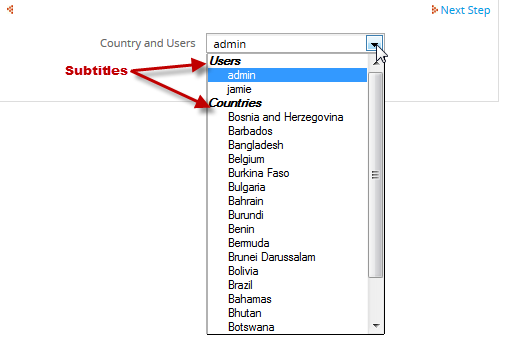
Accessing Dropdowns with JavaScript
The value (not the label) of the selected choice in a listbox is stored in:
getField(" dropdown-name ").value
For instance, if a DynaForm contains the dropdown box named "MyDropdown", the value of its selected option can be read:
var x = getField( "MyDropdown" ).value ;
and it can be changed:
getField( "MyDropdown" ).value = 'valueX' ;
If there is no option in the dropdown box with a value of 'valueX', then the selected pick in the dropdown box volition not change.
The options Assortment
A particular option in a dropdown box tin can be accessed by using its options assortment, which counts the options beginning with the number 0.
getField(" dropdown-proper name ").options[index].selected is a boolean value indicating whether a particular option in the dropdown box or listbox is selected.
getField(" dropdown-name ").options[index].value is the value for an option and getField(" dropdown-name ").options[index].text is its label. The selected and text properties may be both read and changed, but value is read-simply.
getField(" dropdown-name ").selectedIndex is the alphabetize number of the selected option in a dropdown box. This index number can be used to get the value and label of the selected selection, which is stored in the options array:
var idx = getField( "MyDropdown" ).selectedIndex ;
var selectedValue = getField( "MyDropdown" ).options [idx].value ;
var selectedLabel = getField( "MyDropdown" ).options [idx].text ;
To select the second selection in MyDropdown and change its label to "Foo Bar":
getField( "MyDropdown" ).options [ i ].selected = true ;
getField( "MyDropdown" ).options [ ane ].text = "Foo Bar" ;
Looping through the options Array
The number of bachelor options in a dropdown box is stored in getField(" dropdown-name ").length. This number can exist used when looping through the options assortment. For example, to capitalize every option in a dropdown box named "MyDropdown":
var nOpts = getField( 'MyDropdown' ).length ;
for ( var i = 0 ; i < nOpts; i++ ) {
getField( 'MyDropdown' ).options [i].text = getField( 'MyDropdown' ).options [i].text.toUpperCase ( ) ;
}
Adding Options
The createElement() and add() methods can be used to append an selection to a dropdown box. For instance, to add the choice "Contact past Phone" to "MyDropdown":
var opt = document.createElement ( "Selection" ) ;
opt.text = "Contact by Phone" ;
opt.value = "telephone" ;
getField( "MyDropdown" ).options.add (opt) ;
Removing Options
Similarly the remove( alphabetize ) method can be used to remove an option. For instance, to remove the "Contact by Phone" option from "MyDropdown":
var nOpts = getField( 'MyDropdown' ).length ;
for ( var i = 0 ; i < nOpts; i++ ) {
if (getField( 'MyDropdown' ).options [i].value == "phone" )
getField( 'MyDropdown' ).options.remove (i) ;
}
To remove all the options from a dropdown box or listbox, set its length property to 0:
getField( 'MyDropdown' ).length = 0 ;
Changing a textbox depending on a dropdown'southward selection
The following instance changes the value of a textbox depending on what selection is selected in a dropdown. For instance, if a loan needs to exist approved or rejected depending on the amount selected, the code will be:
var changeDrop = function ( ) {
var idx = getField( "Loan" ).selectedIndex ; // proper noun of the dropdown
var selectedValue = getField( "Loan" ).options [idx].value ;
// employ the pick divers on the dropdown
if (selectedValue == 'Op1' ){
getField( 'TxtLoan' ).value = 'Rejected' ; // irresolute the value of the textbox
getField( "TxtLoan" ).way.background = "ruddy" ; // changing the background of the textbox
}
else {
getField( 'TxtLoan' ).value = 'Approved' ; //// changing the value of the textbox
getField( "TxtLoan" ).mode.background = "green" ; // changing the groundwork of the textbox
}
} ;
var dynaformOnload = part ( ) { // calling the function
leimnud.event.add (getField( 'Loan' ) , 'modify' , changeDrop ) ;
changeDrop( ) ;
} ;
The effect will exist:

Accessing Dropdowns with PHP
When a DynaForm is submitted, the value of the selected option in a dropdown box is saved to a case variable with the name of the dropdown box. For example, a dropdown box named "ContactType" has the post-obit options:
A trigger which is fired afterwards the DynaForm is submitted could exist used to bank check for the selected value in the dropdown box. For case the following lawmaking would send out an electronic mail informing an employee how to contact the customer:
if ( @@ContactType == '1' ) {
$template = 'TelephoneClient.html' ;
$subject area = 'Reminder to telephone client' ;
}
elseif ( @@ContactType == '2' ) {
$template = 'EmailClient.html' ;
$subject = 'Reminder to electronic mail client' ;
}
else {
$template = 'FaxClient.html' ;
$subject = 'Reminder to fax customer' ;
}
PMFSendMessage( @@Application, "admin@tiptop.com" , "employee@acme.com" , "" , "" , $discipline , $template ) ;
To fix the option selected in a dropdown box, set its value in the trigger fired straight before the DynaForm is displayed. For example, to select the option "Email" in the to a higher place example, set its value to "two" in the trigger code:
Manually Populating Dropdowns
There are two ways to manually populate the list of options in a dropdown box:
- Adding an associative assortment of associative arrays to $_DBArray and and so querying that array with SQL.
- Serializing an array of arrays equally a JSON string and and then using JavaScript to add the options to the dropdown box.
The get-go method is simpler and doesn't crave writing whatsoever JavaScript lawmaking, but the 2nd method is more than flexible because information technology allows boosted options to be added to an existing listing of options.
Querying the $_DBArray
To populate the list of options in a dropdown box with a trigger, first create an associative array of associative arrays, which is how ProcessMaker internally stores grids and the results of databases queries. This associative assortment of associative arrays can exist queried like a normal table with an SQL SELECT statement.
For instance, to manually populate a dropdown box named "contactMethod", create the following trigger which fires earlier the DynaForm:
$contactOptions = array (
'1' => assortment ( 'Lawmaking' => 'ane' , 'TYPE' => 'Phone' ) ,
'2' => array ( 'CODE' => '2' , 'Type' => 'Email' ) ,
'three' => array ( 'Lawmaking' => 'iii' , 'Blazon' => 'Fax' )
) ;
# Then make $contactOptions available to be queried
# in the DynaForm like a table from a database:
global $_DBArray ;
$_DBArray [ 'CONTACT_OPTIONS' ] = $contactOptions ;
$_SESSION [ '_DBArray' ] = $_DBArray ;
And then, in the DynaForm create dropdown box named "contactMethod" with sqlconnection="dbarray" in its XML definition and an SQL query to access the CONTACT_TYPE assortment. For instance:
SELECT CODE, Blazon FROM CONTACT_OPTIONS
Where CODE will become the "value" for each option and Blazon will go the "label" for each option. The consummate XML definition for the dropdown box would be:
<contactMethod blazon="dropdown" required="0" readonly="0" savelabel="0"
style="edit" options="Array" sqlconnection="dbarray" >
SELECT CODE, Type FROM CONTACT_OPTIONS
<en> Contact Type </en>
</contactMethod>
Populate a Dropdown with a Database Query
To populate the list of options in a dropdown box with a database query, fire a trigger before the DynaForm is displayed which uses executeQuery() to query the database for the value and the label fields used in the dropdown box. Then, assign the results of that query to the $_DBArray as shown in the previous example:
$db = 'XXXXXXXXXXXXXXXXXXXXXXXX' ; //set to the unique ID of the database connection
$contacts = executeQuery( "SELECT CONTACT_ID, CONTACT_NAME FROM CONTACTS" , $db ) ;
//error check that it returned at least one record
if ( is_array ( $contacts ) and count ( $contacts ) > 0 ) {
# Then make $contacts bachelor to exist queried
# in the DynaForm similar a table from a database:
global $_DBArray ;
$_DBArray [ 'CONTACTS' ] = $contacts ;
$_SESSION [ '_DBArray' ] = $_DBArray ;
}
Then, in the DynaForm create a dropdown box which queries the CONTACTS array like a normal database table: For example:
<MyDropdown type="dropdown" required="0" readonly="0" savelabel="0"
fashion="edit" options="Array" sqlconnection="dbarray" >
SELECT CONTACT_ID, CONTACT_NAME FROM CONTACTS
<en> Select Contact </en>
</MyDropdown>
Populate a Dropdown from a Grid
Populating a dropdown box from a grid is very similar to populating from a database query, since both are internally stored as an associative array of associative arrays.
In the post-obit example, a grid named "contactsGrid" has the fields "id", "firstName" "lastName", "address", and "phone". The "id" field will go the value and the "firstname" and "lastname" volition be concatenated to become the characterization for each option in a dropdown box named "selectContact":
//error check that the grid exists and has at to the lowest degree one row
if ( ! isset ( @=contactsGrid) or count ( @=contactsGrid) < 1 )
$aContacts = array ( ) ;
else
$aContacts = @=contactsGrid;
global $_DBArray ;
$_DBArray [ 'CONTACTS' ] = $aContacts ;
$_SESSION [ '_DBArray' ] = $_DBArray ;
Then, in the DynaForm create a dropdown box which queries the CONTACTS array like a normal database table:
<MyDropdown type="dropdown" required="0" readonly="0" savelabel="0"
mode="edit" options="Assortment" sqlconnection="dbarray" >
SELECT id, CONCAT(lastname, ' ', firstname) FROM CONTACTS
<en> Select Contact </en>
</MyDropdown>
Passing JSON Strings of Options
Some other way to populate the list of options is to fire a trigger beforehand which uses the json_encode() function to create a serialized JSON string of options and then pass that serialized string to a hidden field in the DynaForm. When the DynaForm loads, utilize JavaScript to unserialize the JSON string every bit an array of options. And then, utilise the document.createElement() and dropdown.options[10].add() methods to dynamically construct the list of options. This method can exist used to add boosted options to the list of existing options in a dropdown box.
For example, the following trigger is used to construct a listing of products for a dropdown box named "selectProduct". The list of products is serialized and passed to a subconscious field in the DynaForm named "sProducts":
$aProducts = array (
array ( "ARM-100" , "Air Mattress Twin Bed 100" ) ,
array ( "ARM-200" , "Air Mattress Queen Bed 200" ) ,
array ( "ARM-300" , "Air Mattress King Bed 300" ) ,
array ( "ARM-350" , "Air Mattress King Bed Deluxe 350" )
) ;
@@sProducts = json_encode ( $aProducts ) ;
When the DynaForm loads, the following JavaScript code is used to unserialize the "sProducts" hidden field as an array of arrays. Then, the code adds each element in the assortment to the "selectProduct" dropdown using its add() method:
var aProducts = eval(getValueById( "sProducts" ) ) ;
if ( typeof (aProducts) == 'object' && aProducts.length ) { //if an array
for ( var i= 0 ; i < aProducts.length ; i++ ) {
var opt = document.createElement ( "OPTION" ) ;
opt.value = aProducts[i] [ 0 ] ;
opt.text = aProducts[i] [ 1 ] ;
getField( "selectProducts" ).options.add together (opt) ;
}
}
Passing Database Queries To Dropdowns
Similar to the previous instance, the results of a database query tin can be serialized as a JSON string and passed to a hidden field in a DynaForm. The results of a database query are stored equally an associative array of associative arrays, which is more than difficult to deal with since JSON converts associative arrays into objects. In the trigger, transform the associative array of associative arrays into a simple array of arrays earlier serializing with json_encode().
For case, if the products list from the |example to a higher place comes from a database query, and so utilise the post-obit trigger code:
$aProducts = array ( ) ;
$db = "XXXXXXXXXXXXXXXXXXXXXX" ; //database connection unique ID
$products = executeQuery( "SELECT PRODUCT_NO, PRODUCT_NAME FROM PRODUCTS" , $db ) ;
if ( is_array ( $products ) and count ( $products ) > 0 ) {
foreach ( $products equally $product ) {
$aProducts [ ] = array ( $product [ 'PRODUCT_NO' ] , $product [ 'PRODUCT_NAME' ] ) ;
}
}
@@sProducts = json_encode ( $aProducts ) ;
So use the same JavaScript code every bit above, to unserialize the JSON string and populate the "selectProduct" dropdown box.
Passing Grids To Dropdowns
For a filigree, the trigger code would be basically the same. For example, if a filigree named "productsGrid" has the fields "productNo" and "productName":
$aProducts = array ( ) ;
if ( isset ( @=productsGrid) and count ( @=productsGrid) > 0 ) {
foreach ( @=productsGrid as $product ) {
$aProducts [ ] = assortment ( $product [ 'productNo' ] , $production [ 'productName' ] ) ;
}
}
@@sProducts = json_encode ( $aProducts ) ;
Then use the aforementioned JavaScript lawmaking as above, to unserialize the JSON string and populate the "selectProduct" dropdown box.
Saving Lists of Dropdown Options
If using a SQL query to populate the list of options in a dropdown box, continue in mind that the options will change every bit the contents of the database changes. Likewise, dropdown boxes which are dynamically populated with JavaScript based upon users' input will also change their contents. If a subsequent DynaForm or trigger volition need to have access to exactly the same list of options, then employ JavaScript to store the list of options to a hidden field which will be saved as a case variable when the DynaForm is submitted. The list of options can either exist saved every bit a serialized JSON string or as a string formatted like PHP'due south serialize() office.
Saving Dropdown options equally a JSON string
When the DynaForm is submitted, the following JavaScript lawmaking converts the dropdown's options assortment into a JSON string and stores information technology in a hidden field named "sOptions":
function saveDropdownOptions( ) {
getField( 'sOptions' ).value = JSON.stringify (getField( 'MyDropdown' ).options ) ;
}
getField( 'MySubmitButton' ).course.onsubmit = saveDropdownOptions;
Note: The JSON.stringify() function is bachelor in FireFox three.5+ and Internet Explorer 8+, but the json2.js code file volition have to be imported if using older web browsers.
Then, the post-obit trigger is fired afterward in the procedure to convert the JSON string back into an assortment of objects. Then, loop through the array and construct an associative array of associative arrays, which can queried with an SQL SELECT statement to populate a subsequent dropdown box:
$aOptions = json_decode ( @@sOptions) ;
$aNewOptions = array ( ) ;
if ( is_array ( $aOptions ) ) {
$total = count ( array ) ;
for ( $i = 0 ; $i < $total ; $i ++ ) {
$aNewOptions [ $i + one ] = array ( 'VALUE' => $aOptions [i] .value, 'Label' => $aOptions [i] .text) ;
}
}
global $_DBArray ;
$_DBArray [ 'OPTIONS_LIST' ] = $aNewOptions ;
$_SESSION [ '_DBArray' ] = $_DBArray ;
Finally, a subsequent DynaForm uses the following SQL query to populate its list of options in a dropdown box:
SELECT VALUE , Label FROM OPTIONS_LIST
Saving Dropdown Options equally a serialize() string
The following JavaScript lawmaking saves the listing of options as a serialized 2 dimensional array which tin can be decoded with PHP's unserialize() function. The serialized string is stored in a hidden field when the DynaForm is submitted. The code loops through the options and saves each pick in a serialized inner array with the value and label and so sticks that array within a serialized outer array:
// function to create serialized 2 dimensional array in following format:
// a:2:{i:0;a:2:{i:0;due south:6:"value0";i:1;s:six:"label0";}i:1;a:2:{i:0;s:6:"value1";s:6:"label1";}}
function saveDropdownOptions( ) {
var nOpts = getField( 'MyDropdown' ).length ;
var sOpts = "a:" + nOpts + ":{" ;//start a serialized two dimensional assortment
for ( var i = 0 , var value, var characterization; i < nOpts; i++ ) {
value = getField( 'MyDropdown' ).options [i].value ;
characterization = getField( "MyDropdown" ).options [i].text ;
sOpts += "i:" + i + ";a:2:{" ;//kickoff inner array of two elements
sOpts += "i:0;s:" + value.length + ':"' + value + '";"' ; //add together value element
sOpts += "i:i;s:" + value.length + ':"' + value + '";"' ; //add together label element
sOpts += "}" ;//close array inner array
}
sOpts += "}" ; //close outer array
getField( 'MyHidden' ).value = aOpts;
}
getField( 'MySubmitButton' ).onclick = saveDropdownOptions;
A subsequent trigger will exist able to admission the list of options by unserializing it. For instance, the post-obit trigger code would place the options in a case variable named @@MyTextArea so it can be displayed in a textarea field a subsequent DynaForm:
$arrayOptions = unserialize ( @@MyHidden) ;
@@MyTextArea = "" ;
foreach ( $arrayOptions as $option ) {
$value = $option [ 0 ] ;
$label = $pick [ i ] ;
@@MyTextArea .="$value: $label \n" ;
}
 YesNo
YesNo
Aye/No dropdown boxes are designed to present a binary option to the user. Different a checkbox, the values in a Yeah/No dropdown box can not be customized and are e'er "Yes" or "No. Checkboxes are more convenient for the user, since they involve a uncomplicated click, rather than a click and concord, select and release action. However, Yes/No dropdown boxes tin be useful when the words "Yeah" or "No" need to exist displayed or when presenting a binary option in grid forms, where checkboxes do non part.
Properties
- Field Name *Required
- Label
Behavior
- Required
- Read Only
- Default Value
Appearance
- Mode
Accessing Yes/No Boxes with JavaScript
Yes/No boxes can exist accessed with JavaScript but like dropdown boxes. They have just two options:
- value: "0" characterization: "NO"
- value: "i" label: "Aye"
To set a Yes/No box to "Yep":
getField( "myYesNo" ).value == "i" )
To set a Yes/No box to "NO":
(getField( "myYesNo" ).value == "0" )
To bank check if a Yes/No box has selected the "Yes" pick:
if (getField( "myYesNo" ).value == "1" )
//do something
To check if a Yeah/No box has selected the "NO" option:
if (getField( "myYesNo" ).value == "0" )
//practise something
To modify the label of the "Yep" selection in a Yeah/No box to "Approved":
getField( "myYesNo" ).options [ 1 ].text == "Approved" ;
Accessing Yeah/No Boxes with PHP
The value of Yes/No boxes is stored every bit ane for "Yes" and 0 for "No". If using a Yep/No as a example variable in a condition, cheque for "Yes" with:
Or:
And cheque for "No" with:
Or:
 Listbox
Listboxes allow one or more options to be selected from a list of options.
Listboxes are more convenient to use than dropdown boxes, since they practise not require clicking and belongings downwardly on the mouse to run into the list of available options. Their disadvantage is that listboxes occupy more space than dropdown boxes and tin can not be included in grid forms, since they practice not fit well in rows in a table.
Properties
- Field Proper noun *Required
- Characterization
Beliefs
- Required
- Default Value
Appearance
- Size
- Mode
Data
- Sql Connection
- Sql
Options
Unlike dropdown boxes, listboxes let for a variable number of options to be selected. If there are more options than can be displayed at a fourth dimension, vertical scrollbars will automatically appear to allow the user to curl to the other options. To select an option, click on it with the mouse. Use the UP and LEFT arrow keys to select the previous option in the list or the Downwardly and RIGHT arrow key to select the next choice in the list. PAGEUP and PAGEDOWN volition select an option which is located one screen up or down in the listing. CTRL+Domicile will select the kickoff option in the list, while CTRL+Stop volition select the last selection.
Multiple options can be selected by holding down on the CONTROL key while clicking options with the mouse or pressing one of the keys listed above. Besides, hold down on the CONTROL key while clicking the mouse or pressing a primal to unselect a previously selected pick. To select all the options between the previously selected option and current choice, hold down on the SHIFT key while clicking the mouse or pressing a key.
The Size holding in listboxes determines their height in lines, which is set to 4 by default. Their width is automatically set up to the widest selection in the list.
Similar dropdown boxes, each option in listboxes have both a value, which is what is stored when a user selects an pick and the label, which is the text displayed to the user. Listboxes can have its list of options defined in its XML definition. In addition, it tin append extra options to the list with an SQL SELECT statement.
Accessing Listboxes with JavaScript
Listboxes can be accessed through JavaScript in the same way that dropdown boxes are accessed. getField(" listbox-proper noun ").value only stores the first selected option in a listbox. Therefore it is necessary to loop through all the options to discover all the selected options for a listbox. For instance, to create an array of all the selected options in MyListbox:
var nOpts = getField( 'MyListbox' ).options.length ;
var selectedOpts = new Array ( ) ;
for ( var i = 0 ; i < nOpts; i++ ) {
if (getField( 'MyListbox' ).options [i].selected )
selectedOpts.push button (getField( 'MyListbox' ).options [i].value ) ;
}
Accessing Listboxes with PHP
When a DynaForm is submitted, the values of the pick(s) selected in a listbox are stored in a cord in a instance variable with the same proper name as the listbox. If multiple options are selected, the values are separated by '|' (pipes). To discover out whether a item option was selected, suspension the string of selected values into an array with the explode() office, then use the array_search() or in_array() functions to bank check if the choice's value is in the array. If no pick is selected in a listbox, the case variable will not be created.
For example, the "selectManagers" listbox is used to select which managers should review a report. The following trigger code sets the @@districtManagerReview and @@ceoReview cases variables which are used in subsequent conditions in a parallel fork routing rule. Here is how to check for the values selected in a listbox named "MyList" with trigger code:
@@districtManagerReview = "no" ;
@@ceoReview = "no" ;
# Cheque if something was selected in the listbox:
if ( isset ( @@selectManagers) and is_string ( @@selectMangers) ) {
# intermission the cord into an array, each chemical element containing a selected selection:
$aManagers = explode ( '|' , @@selectManagers) ;
if ( in_array ( "district_manager" , $aManagers ) )
@@districtManagerReview = "yes" ;
if ( in_array ( "ceo" , $aManagers ) )
@@ceoReview = "yes" ;
}
Manually Populating Listboxes
The options in a listbox can be populated in the aforementioned way as dropdown boxes by either adding an associative array of associative arrays to $_DBArray and then querying that assortment with SQL or by passing a JSON string of options to the DynaForm and using JavaScript to add the options to the listbox.
Preselecting Options in Listboxes
To set which options will exist selected in a listbox, burn down a trigger beforehand which will create a string with each option's value separated by '|' (pipes). If only one option is selected, then no '|' (pipes) are needed.
For case, to preselect the options "ceo", "district_manager" and "local_manager" in the "selectManagers" listbox:
@@selectManagers = "ceo|district_manager|local_manager" ;
The list of options in a listbox tin be populated with a database query divers in the Sql Connection and Sql backdrop for the listbox, however these properties do not allow for the preselection of options in the listbox. To employ a database query to preselect options in a listbox, create a trigger which fires before the DynaForm to set the value of the case variable for the listbox.
For instance, the "selectTeamMembers" listbox has its listing of employees populated with the following SQL query in the wf_
SELECT USR_UID, CONCAT(USR_FIRSTNAME, ' ' , USR_LASTNAME, ' (' , USR_USERNAME, ')' ) FROM USERS
The following trigger preselects the 3 users with the fewest cases with "TO_DO" status to automatically be in the team:
@@selectTeamMembers = "" ;
$query = "SELECT AD.USR_UID, COUNT(Ad.USR_UID) Equally NUM_CASES
FROM APP_DELEGATION Advert, APPLICATION A
WHERE A.APP_STATUS = 'TO_DO' AND A.APP_UID = AD.APP_UID
Gild BY NUM_CASES" ;
$users = executeQuery( $query ) ;
if ( is_array ( $users ) and count ( $users ) > 0 ) {
for ( $i = 1 ; $i <= iii and $cnt <= count ( $users ) ; $i ++ ) {
@@selectTeamMembers += ( empty ( @@selectTeamMembers) ? '' : '|' ) . $users [ $i ] [ 'USR_UID' ] ;
}
}

Xml Binary Option Yes Or No,
Source: https://wiki.processmaker.com/index.php/2.0/Dropdown_Boxes_and_Listboxes
Posted by: sokolowskisairenecons97.blogspot.com
0 Response to "Xml Binary Option Yes Or No"
Post a Comment